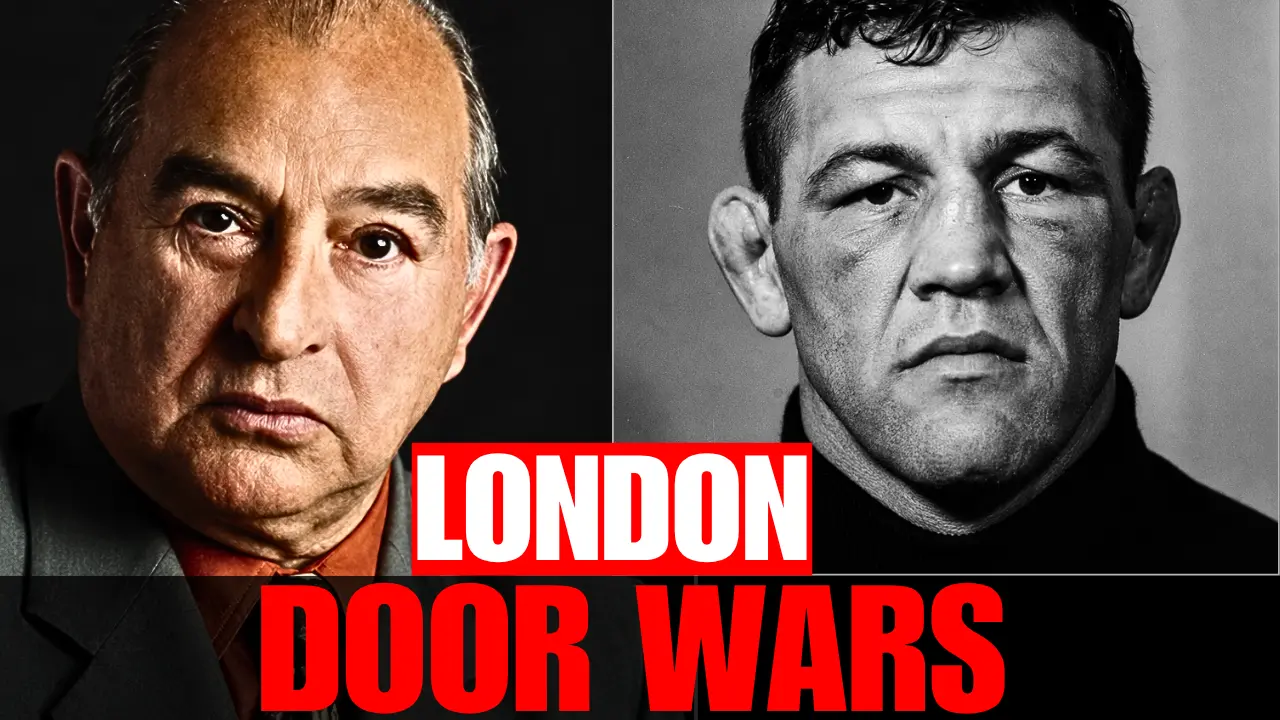
One night in Fred Foreman’s club, a man punched a seventeen-year-old girl hard enough to break her jaw. She was carried out unconscious. The bully and his gang then armed themselves with pickaxe handles, ready to take on Foreman and his crew outside.
What followed would cement Foreman’s reputation as one of the most feared men in London’s criminal underworld. This is the story of Club 211, Balham — a cruel act of violence against a young woman, and the savage retribution that came after it.
Brown Bread Fred
Fred Foreman was not called the Managing Director of British crime for nothing.
In respectable company he was polite, well-dressed, quietly spoken. The kind of man you would be happy to have a drink with and think quite the gentleman.
In the underworld, something else entirely.
Foreman was not a man who gave orders from the back of a room. He could fight. He had proved it. And in 1960s London clubland, that mattered more than almost anything else.
Because London in the 1960s was the Wild West.
People talk about the Krays and the Richardsons. The famous firms. But Foreman himself said it clearly — it was not just the well-known names. There were hundreds of dangerous, armed outfits spread across every borough. Robbers, gangsters and hard men with crews behind them, all of them ready to hurt or kill if the situation called for it.
The clubs and casinos sat right in the middle of all that. Cash businesses. Late nights. Drink. Gambling. Serious money moving across a table in a single evening. If you ran one, you needed to be the most dangerous thing in the room — or you needed someone who was.
The 211 Club, Balham High Road
The 211 Club stood on Balham High Road. From the outside it looked smart — roulette tables, blackjack, croupiers in dinner suits, customers coming from across London.
Foreman had been brought in by Bernie Coleman, a south London pub owner with an interest in the place. Local villains had been testing the edges. The moment Foreman’s name was attached to the 211, that stopped.
Around him he assembled the men the club needed: Ronnie Oliffe, Ronnie King, Johnny Cook, Lenny White, Micky Regan. Not doormen checking guest lists. Hard men whose names alone could change the atmosphere in a room.
Foreman had a name for the ones who kept causing problems. Saturday Night Cowboys. Ordinary working men who would behave themselves all week, then arrive mob-handed at the weekend, full of drink and nerve, thinking a busy club was somewhere they could do as they pleased.
They were wrong.
Johnny Hanlon
Before we get to the worst night the 211 ever saw, there is a man you need to know about. Johnny Hanlon. West London. Hard as they came.
Hanlon was not a gangster in any organised sense. He was something, in some ways, more frightening. A street fighter. Fearless, violent, completely unpredictable — and by the accounts of people who were there, genuinely terrifying.
The pubs and clubs around his patch knew his name well. Some of them paid him. Not for protection in the traditional sense. To stay away. Because having Hanlon walk through the door on a busy Saturday night meant one thing — somebody was going to get badly hurt, and it almost certainly was not going to be him.
Then one night, Hanlon walked into the 211. He did not know whose place it was.
He was about to find out.
Hanlon came in the way he always did — with his entourage around him, already making his presence felt. Foreman had seen it a hundred times. He walked over, took Hanlon’s drink, and told him to leave.
That was the moment Hanlon made the worst mistake of his life.
He moved towards Foreman.
What he had not noticed was Ronnie Oliffe — leaning nearby, watching, waiting. Before Hanlon could do anything, Oliffe hit him with a right hand. Hanlon was out before he hit the floor.
The man who had terrorised west London pubs for years. The man publicans paid money just to keep from their doors. Knocked unconscious by a single punch before he even knew it was coming.
No drawn-out confrontation. No chance to perform for his crew. Just the floor.
Years later, inside Wormwood Scrubs — where Foreman was serving a sentence connected to the Jack McVitie murder — a man approached him in the yard. Johnny Hanlon.
He looked at Foreman and said: are you Fred? Freddie Foreman?
Foreman offered him the recess. A quiet corner where things could be settled if Hanlon still had something to prove.
Hanlon did not want it. He apologised and held out his hand. Foreman shook it.
That was the old code. A man could be knocked unconscious, cross paths with you years later inside a prison, and if he came correctly, the matter was finished. But not every story from the 211 ended that way. Some ended very differently.
The Worst Night at the 211
The trouble started downstairs in the bar.
A gang had come in — around a dozen men. At the front was a man Foreman called Flat Nose, an ex-fighter who was big and completely without any sense of where the line was.
Flat Nose punched a seventeen-year-old girl. Not pushed her. Not shoved her. Punched her — hard enough to knock her unconscious, hard enough to break her jaw. She was a customer. A young woman out for an evening in a smart Balham club.
Foreman and Micky Regan came downstairs. But the gang were already moving for the door, getting into cars.
Foreman and Regan followed them out.
Across the road, Flat Nose and another man had stopped. They went to the boot of their car and pulled out pickaxe handles. A statement. A show of strength. A message that out here on the street, it was going to go differently.
It was the wrong move.
Foreman had already collected a .38 pistol from upstairs. He called it the equaliser. He was not carrying it for show.
When the two men came forward with the handles, Foreman pulled the gun. They stopped. He told them to drop the sticks. The handles hit the road.
Then Foreman went for Flat Nose. He hit him. Hit him again. Then pistol-whipped him around the head. This was punishment — deliberate, personal punishment from a man who had just watched a teenage girl carried out unconscious with a broken jaw.
Micky Regan dealt with the other man.
Then Foreman put the gun into Flat Nose’s shoulder and pulled the trigger. The bullet entered the shoulder and travelled through his body before exiting through his side. Somehow it missed the major arteries. Somehow it missed the heart.
Foreman turned to the second man, warned him never to come near the 211 again — then put the barrel of the gun behind his ear and fired. The blast took the ear clean off.
Aftermath
Foreman and Regan went back inside and cleaned themselves up.
One of the injured men managed to get behind the wheel and drive himself and Flat Nose to hospital. The girl with the broken jaw ended up in the same building.
Police were called. No statements were made. Nobody had seen anything. In that world, in that era, that was simply how it worked. The law existed somewhere else. In the clubs and the streets around them, other rules applied.
According to Foreman, Flat Nose and his associate understood that what they had received that night was a taster — not the full measure of what was available to them if they pushed it further.
They were never heard from again.
The Contradiction
Fred Foreman is, in many ways, a contradiction.
He will tell you himself — he was brought up to behave as a gentleman in every aspect of life. Manners, respect, conduct. People who knew him well describe a man who genuinely lived by those values.
And yet he shot a man in the shoulder outside a Balham club and took another man’s ear off with a pistol. He was convicted in connection with the disposal of Jack McVitie’s body. He stood at the centre of one of the most dangerous criminal networks Britain has ever produced.
The underworld had its own codes. Its own logic. By those standards, Foreman was consistent. He did not hurt people for sport. He did not cross lines that his world considered lines. When the violence came, in his mind at least, it came for a reason.
Which brings us back to Johnny Hanlon.
Years after the night Ronnie Oliffe put him on the floor of the 211, Hanlon continued pushing — testing people’s patience. Eventually he pushed the wrong ones too far. According to Foreman, while he was in Spain he was approached and asked to kill Hanlon. He refused. Not because he was frightened of the consequences. But because he was not a contract killer. That was his line, and he held it.
Make of that what you will.
Remarkably, both men are still alive today. Fred Foreman and Johnny Hanlon. Two of the last elder statesmen of a London that no longer exists. A city that was wilder, more brutal, and in its own way governed by codes that the men inside it took seriously.
That world is gone. But the men who lived it are still here.
If you want more on Fred Foreman, the Enquirer 2.0 channel has another story — a lifelong feud with a dangerous gunman who shot his brother, the revenge that followed, and the years-long hunt for the man responsible. Watch it on YouTube.